
We knew that platforms like BuiltWith and Wappalyzer maintain their own lists of Umbraco websites. They’re generally doing a very good job but, curious as we always are, we wanted more structured and comprehensive information - not only on how many Umbraco sites there are out there, but also how active they are, what Umbraco version they are on, where they are located, what sectors they belong to - and combinations of the above.
So we decided to do two things:
- Get hold of an as huge as possible website dataset. We were lucky enough to stumble upon DataLabs, which maintains a free list of over 22 million records at https://docs.peopledatalabs.com/docs/free-company-dataset in CSV format. This would be a good enough sample to start with.
- We wrote our own Umbraco Checker. This was a CLI application that could verify whether a site was Umbraco or not. We purposefully made it as less intrusive as possible, checking just the home page and the /umbraco URL and utilizing various signals to also determine the Umbraco version as closely as possible.
We then ran the checker over the 22m dataset, and, as expected, a small percentage of those sites ended up being Umbraco.
To be more specific, we found approximately 25k verified Umbraco websites. There were probably more, but we could not verify sites which might have their /umbraco login page protected or its URL changed, or were blocked by WAFs.
Still, over 25k Umbraco websites were a decent sample to get information about. Questions we needed to answer were:
- How many of those were still in older versions that are out of support?
- How many are still in v4? (Fortunately, not many!)
- When were they last updated?
The answers were revealing - and utterly surprising!
Legacy versions everywhere
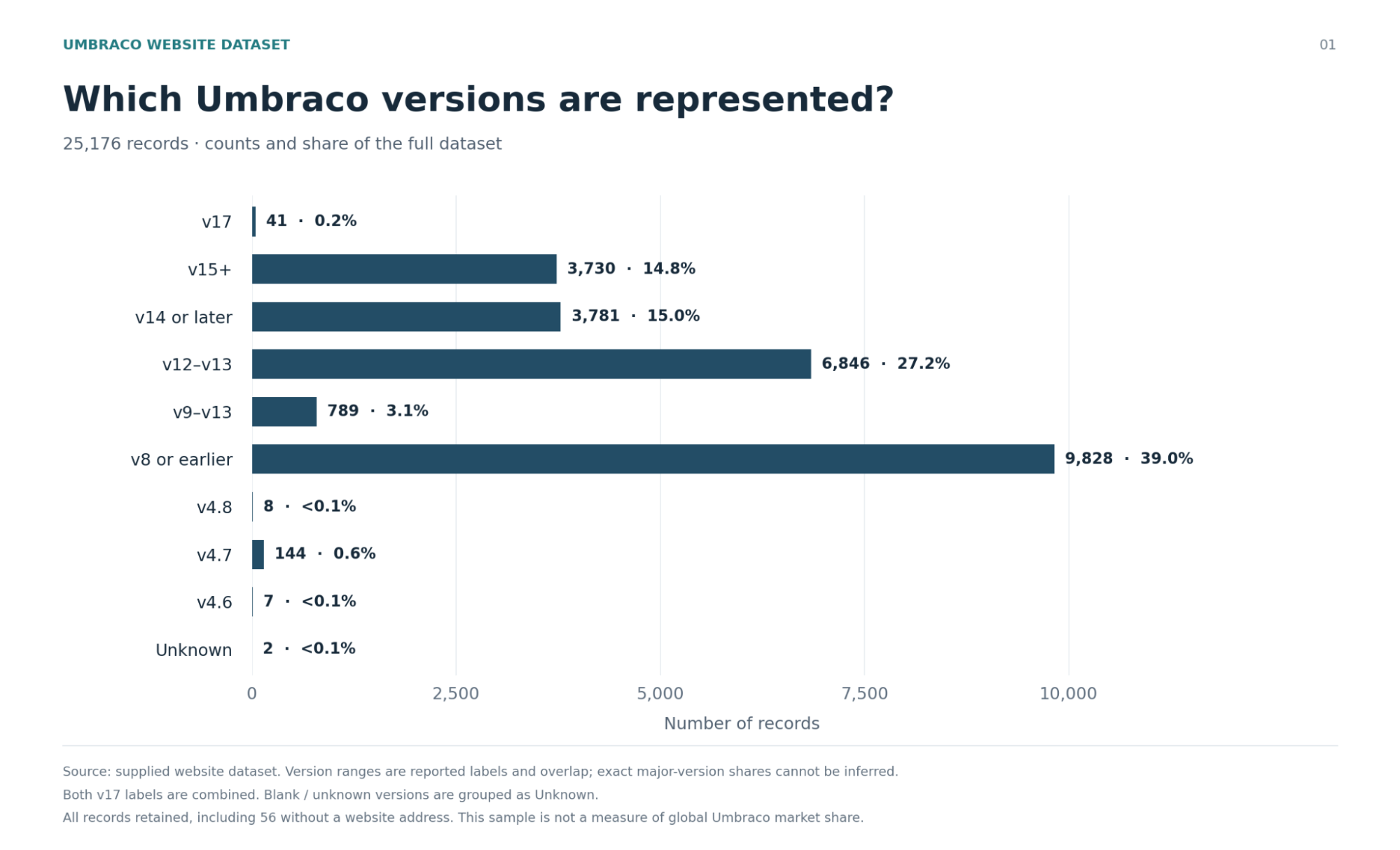
A whooping 39% of the websites checked were still in v7-v8, with an additional 3.1% being on the soon-to-be-in-EOL v13. Fortunately, the v4 versions were extremely few, but it looks like v4 is still alive and kicking.
Very few sites seem to have been upgraded to v17. Of course, the sample might have some bias, and the method is not really scientific, so we cannot really judge that. As an indicator, though, it shows us that people tend to upgrade slower than Umbraco and Microsoft do.
This, of course, presents an opportunity for Umbraco and many Umbraco Partner agencies to educate their clients, especially those in earlier versions, that they should consider an upgrade. Our take is that the 39% owes its existence to the old “if it works, don’t fix it” motto. But we all know that’s not always the case.
Are they alive?
The next thing we wanted to check is whether legacy sites are really updated. The method we used to do that was to pull their sitemaps (where available) and check the last modified dates.
Even if the content itself wasn’t really updated and the sitemap’s dates changed as a result of a deployment, it would show us that some activity was actually taking place.
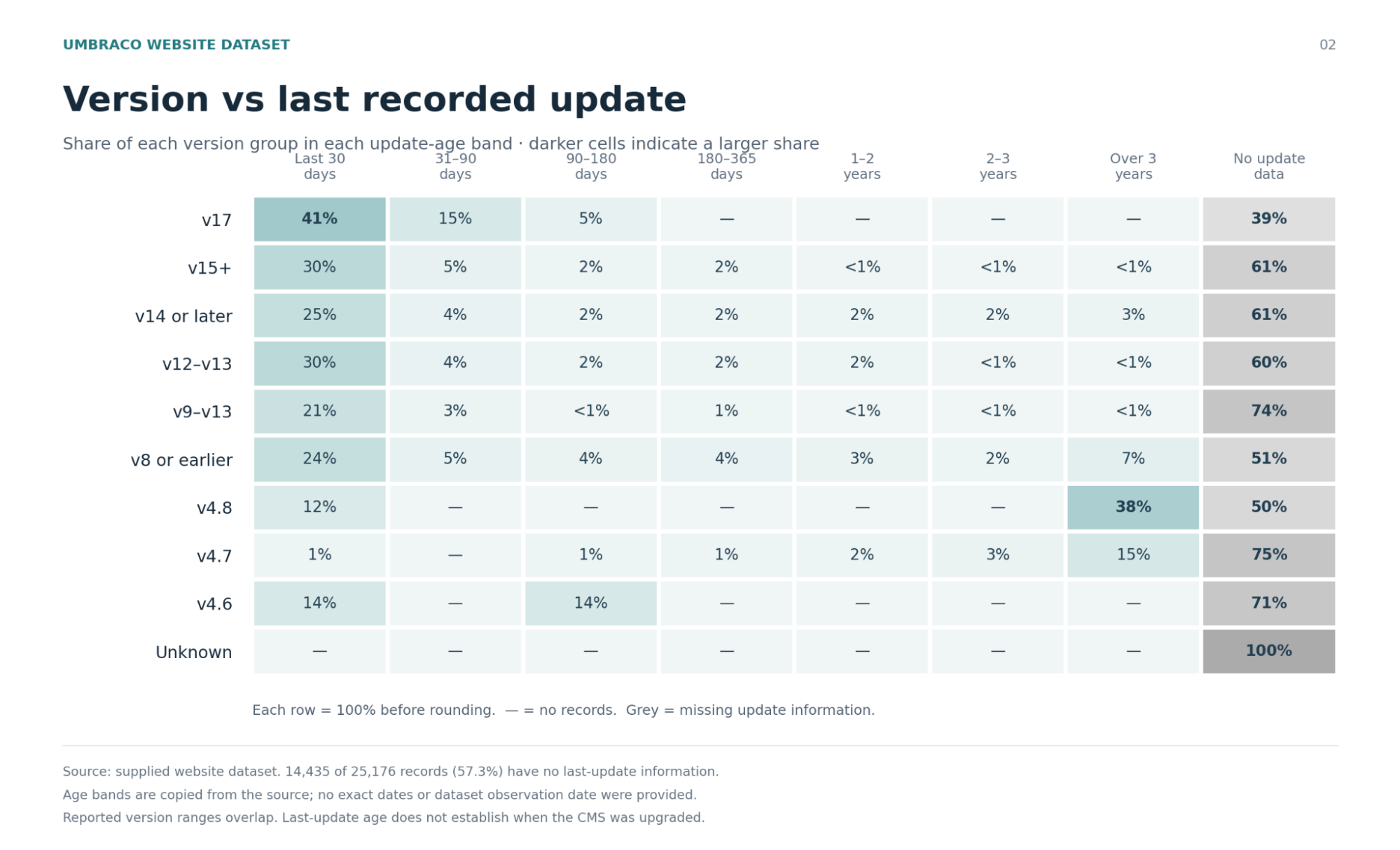
The results were encouraging. Although we could get information on less than 50% of the total websites, we saw that for v7/v8 websites, a significant percentage had been updated at least once during the last 30 days - meaning the websites were well alive. The percentage rises to 29% for updates that took place over the past 3 months.
A significant percentage (38%) of sites on v4 have not been updated for over 3 years. This is somewhat expected, but still impressive.
Most sites that are on versions later than v8 are generally updated, so no surprise there. If their owners took the trouble to upgrade them, why not take care of the content as well!
Forgotten doesn’t necessarily mean dead or abandoned
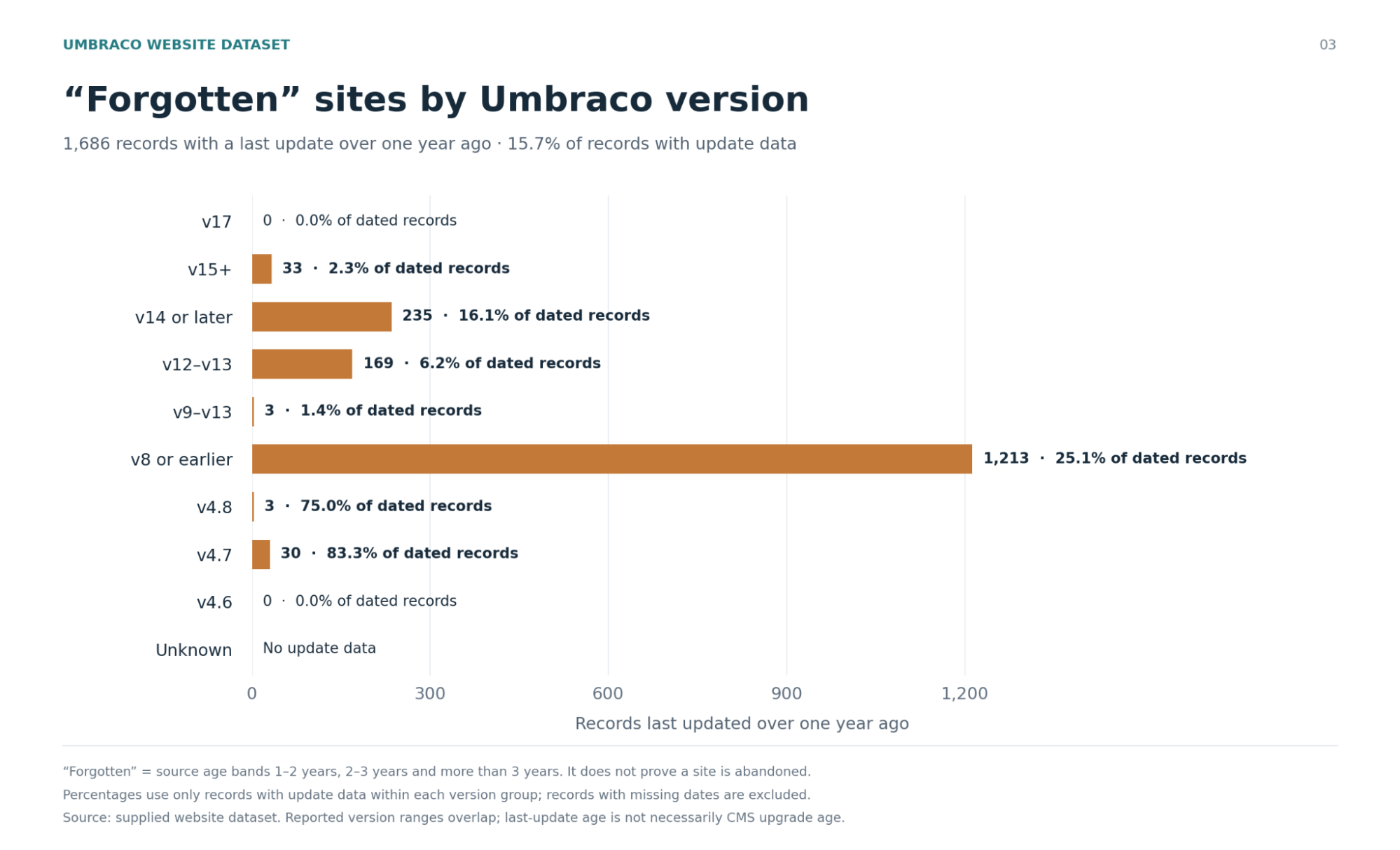
Another chart gives a better view of where the “forgotten” websites reside. It’s clear that v8 holds the majority of inactive websites among all versions - that’s because there are so many sites still at v8.
And this is the real issue which the data cannot reveal - why are these sites still active but, effectively, “zombiefied”? Our guess is that most of them were brochure sites for which the owners didn’t want to invest more - neither in upgrading them nor updating the content. They’re just there, they’re doing their job, and nobody will probably shed a tear if they go down. But, of course, that’s just speculation.
Where are they?
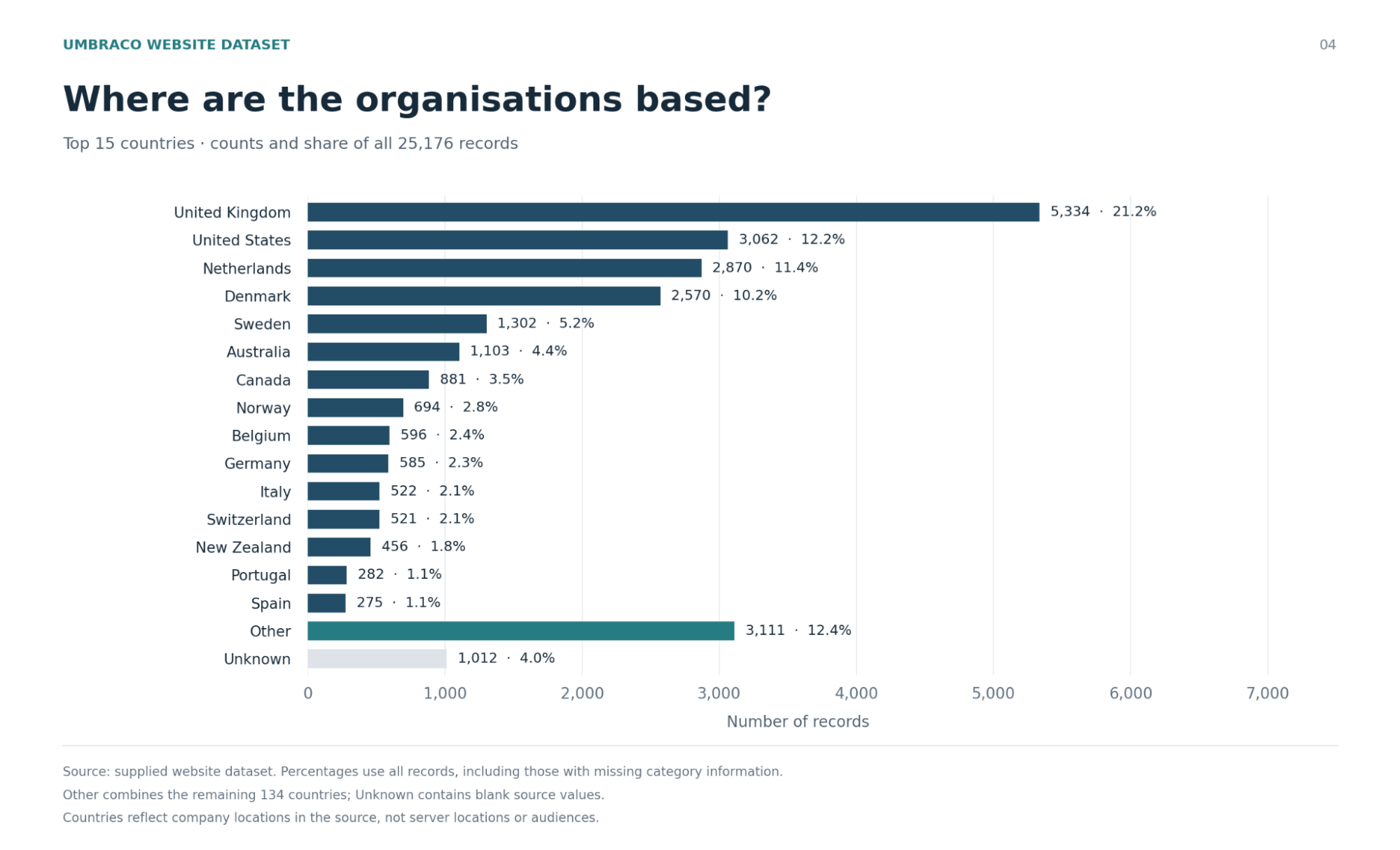
Another question we had was what nationality the sites reside under. The results were somewhat expected: The UK holds the lion’s share of Umbraco websites, followed by the United States (which can be considered somewhat unexpected), and naturally followed by Northern Europe (Netherlands, Denmark, Sweden).
Australia and Canada are yet another surprise - we were expecting a somewhat smaller adoption. For Australia, though, let’s not forget that Umbraco started Australian Cloud Hosting support in 2023 - they probably knew what they were doing!
As a disclaimer, the dataset’s location field indicated where the company’s HQ was located - some of the website may actually reside in different countries.
The version distribution is pretty similar for all the top Umbraco countries. Each country has its own share of legacy v7/v8 Umbraco installations, with Belgium and Australia being the champions - the UK, on the other hand, seems to be going better with upgrades, however there’s a big chunk still on V13.
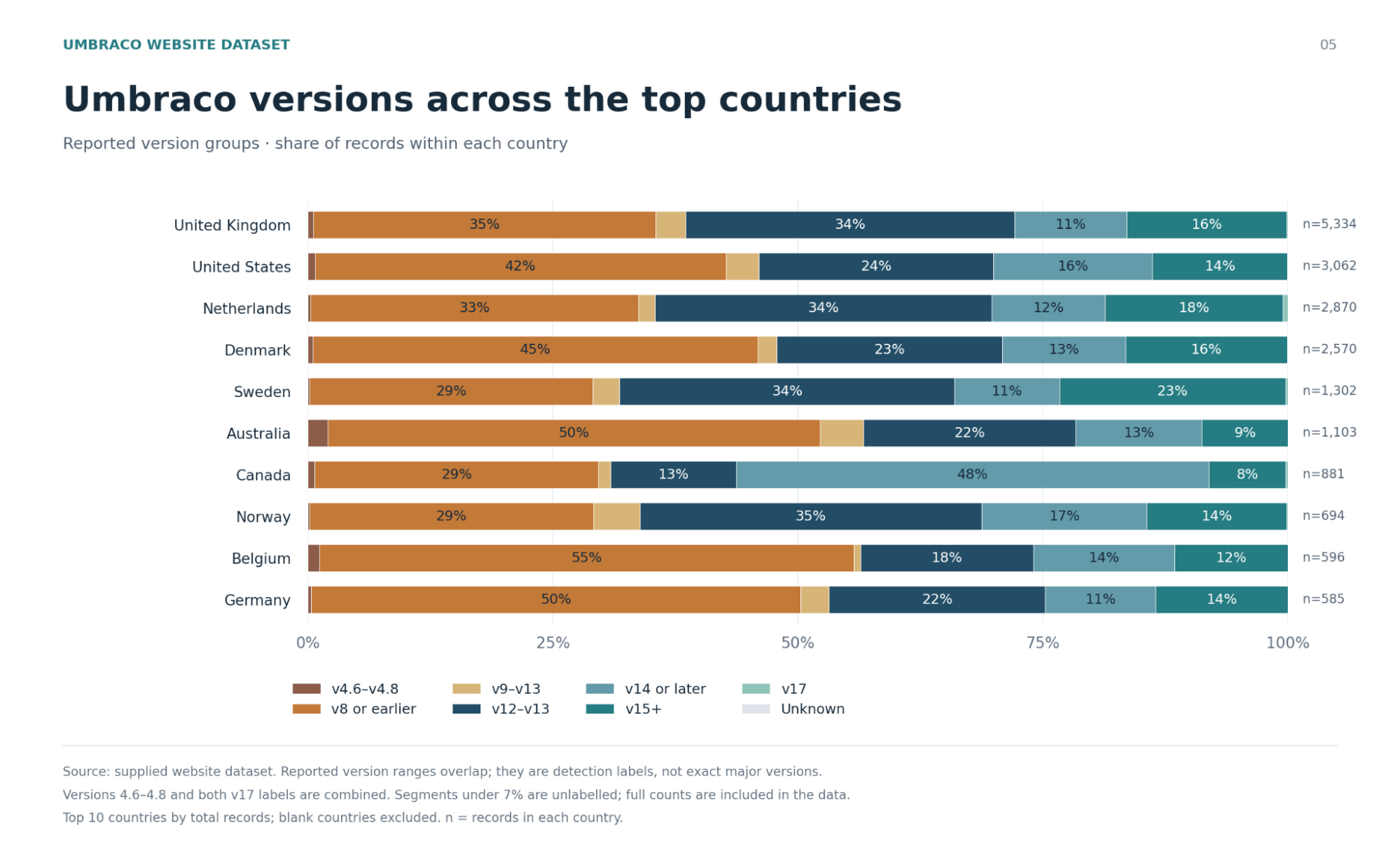
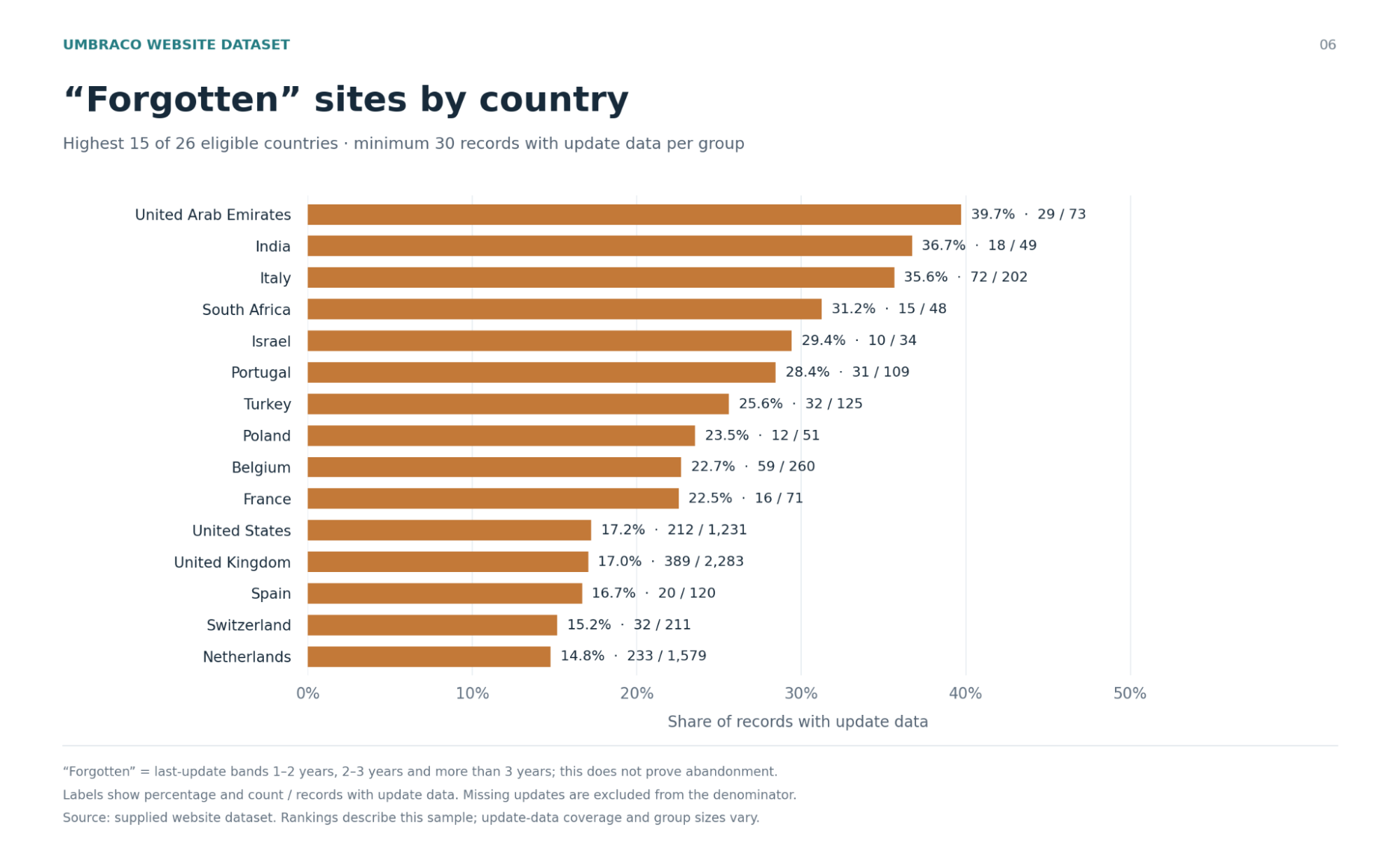
What comes as a surprise is the next chart - it shows us the countries where most of the “abandoned” websites (the ones that haven’t had an update for very long) are. UAE? India? Italy? Reason unknown - if you know more than we do, please let us know!
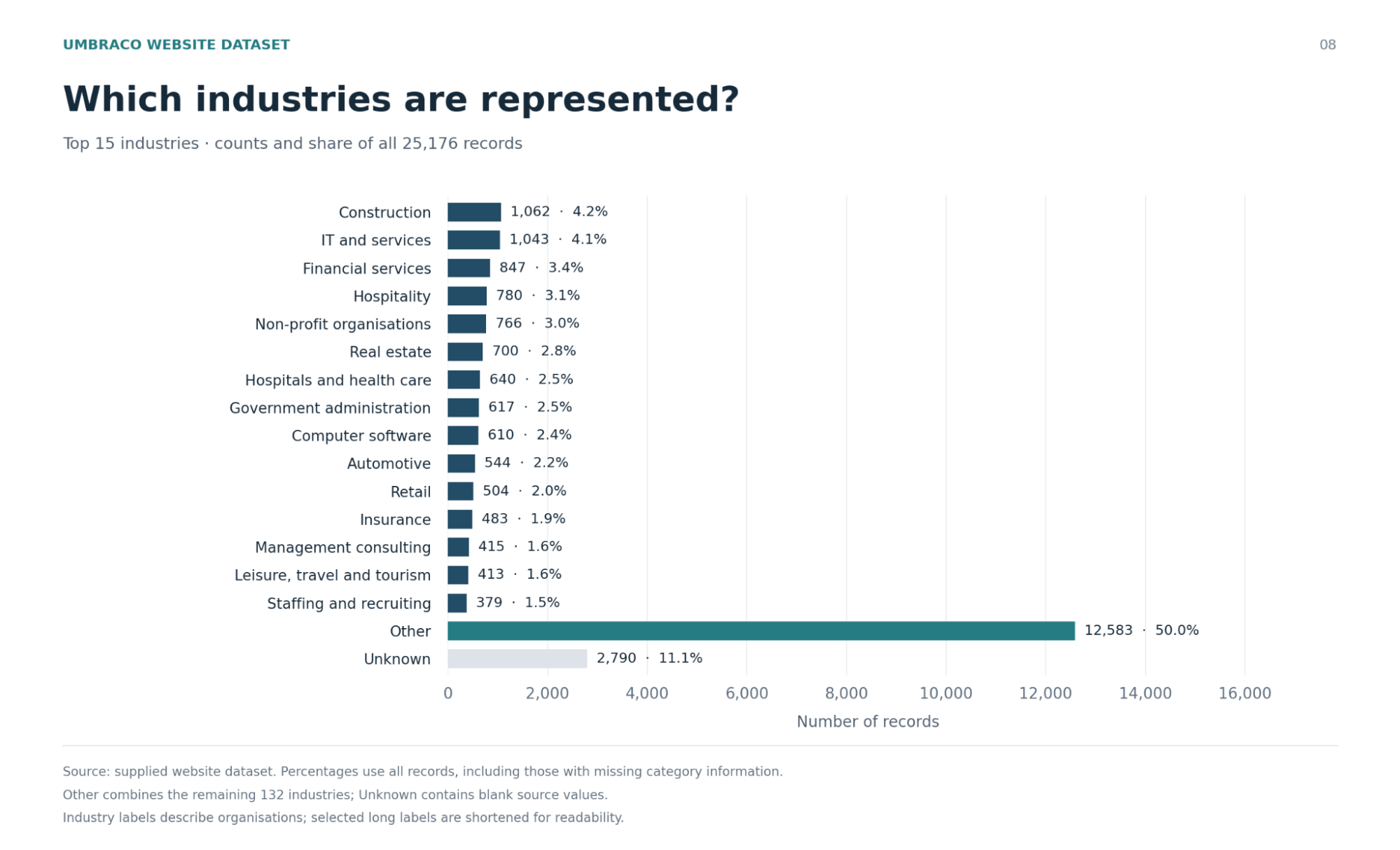
Umbraco is popular in Construction!
The dataset had an industry column, so we thought of making a chart with how industries are using Umbraco. Although we expected IT and financial services to be on top, construction is the winner.
Size (probably) matters
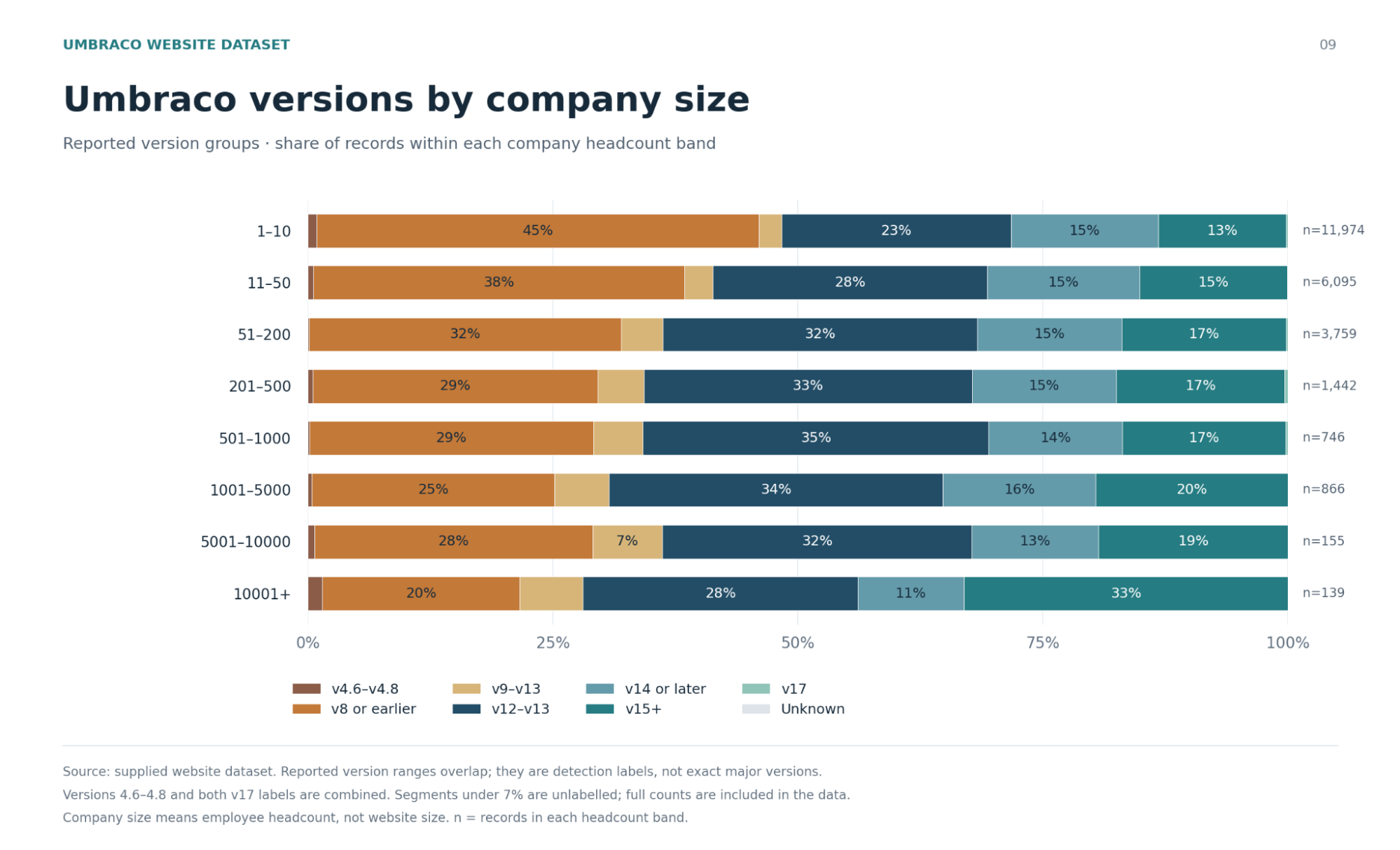
It’s a cliche. Yes. But it looks like the larger the company, the more updated their Umbraco websites are in general. This, of course, possibly stems from the requirements for compliance and security that are more demanding across larger companies.
On the other hand, smaller companies may tend to maintain legacy versions due to budget constraints or, in some cases, just lack of information. This is, again, just speculation on our side and may not accurately reflect reality.
What could be considered as an opportunity for Umbraco and Umbraco-related agencies, though, is that there’s a large chunk of v13 installations out there, on larger companies. These should be upgraded soon.
Was that all?
Of course not. Having the checker in place, we decided it would be good to extend it so it can catch more information than just versions, such as basic SEO, Accessibility, and Security issues, and share its functionality with the world. You can find a web-based version of the checker here: https://www.dot-see.com/check-your-umbraco-sites-health/ - it will only check your site if it is Umbraco, and send you a report with its findings.
We’re constantly evolving the checker, and we’re adding more signals that could be useful to site owners wanting to see where their Umbraco websites stand. However, we’re trying to keep it non-invasive so we’re not performing directory scans, auth attempts or other weird stuff. The information we can pull out of a single, public-facing webpage is inherently limited, but it can still provide some good indicators on your site’s health, and it’s free. So go for it!
Technical info
The Checker is a NET10 application with a CLI and an API endpoint version, accessible only through our own website. It is not accessible as a stand alone web application.
We used Claude Code in developing the checker as well as putting the checker to use together with the dataset.
We used ChatGPT for generating the diagrams in this article.
The Checker might have introduced a limited number of false positives as well as false negatives. We have taken care so that is as limited as can be.
Disclaimers
This research is not scientific. The sample is not random and might be biased. All of our charts come from examining the specific dataset provided and might deviate from the actual picture. Everything presented here is provided for informational purposes only and it is not suggested that it is used for business decisions on its own.
No, we won’t ever give the processed dataset to marketers, or anyone else.